

|
Author :
Nisha Sharma |
Choosing a university is now easier than ever before. Just a simple search will give hundreds of options, all of which promise to provide recognised degrees, excellent placements and flexible learning. But before you start comparing fees and applying, there is one very important question that you must ask yourself. Is the university UGC approved?
Many students across India often come across the term ‘UGC Approved Universities in India,’ but do they know its meaning? Does ‘UGC Approved’ mean that the degree is valid, or does UGC approve every university in India? What is UGC Recognition and what is UGC-DEB Entitlement all about? These are some of the most common questions that students face when considering admission to these institutions.
The answer is simple. The UGC approvals signify whether a university has been recognised by the University Grants Commission which certifies it to grant degrees under the UGC Act. Additionally, if you want to study through an online or distance program. You need to make sure that the university has UGC-DEB entitlement to offer the online program or the ODL program of your choice. UGC approval is an important criterion to check before taking admission.
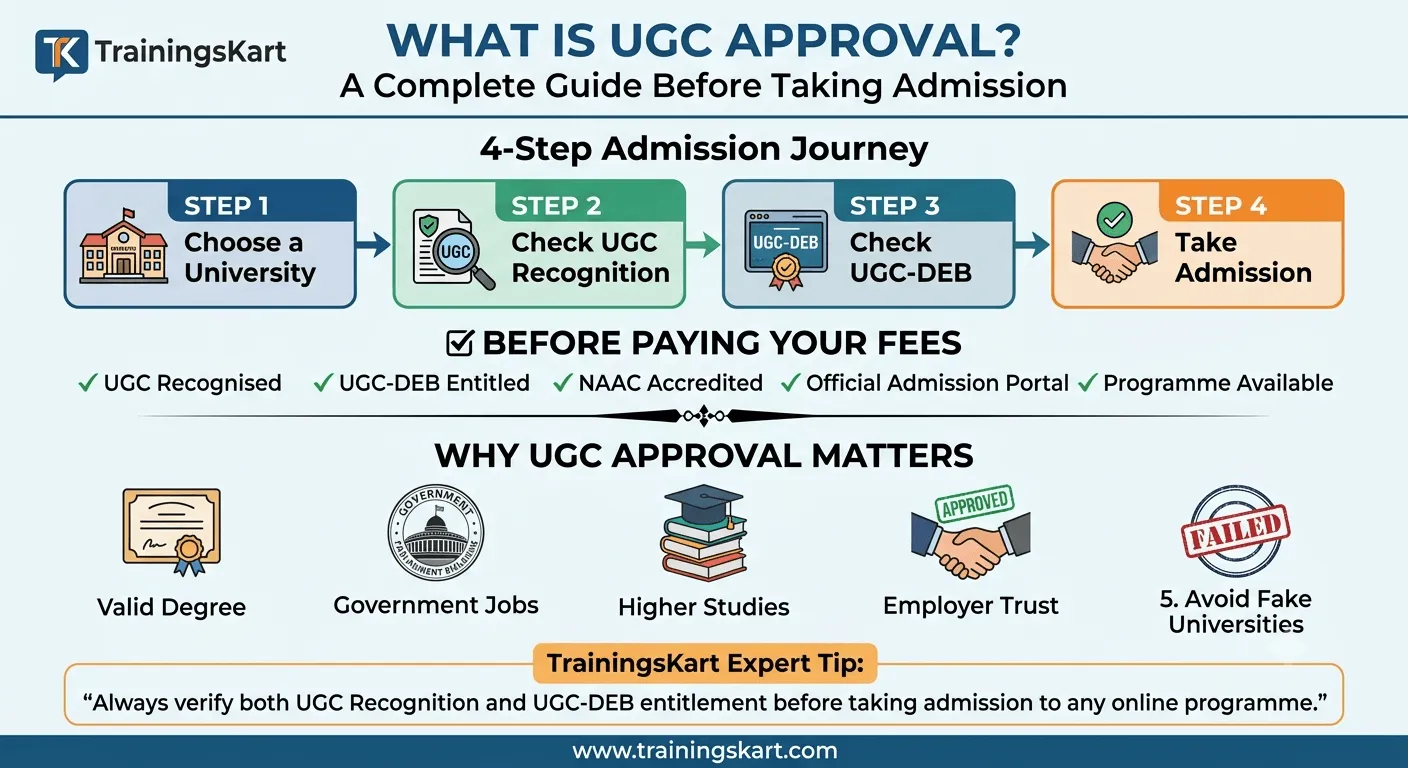
When a student hears the term 'UGC approved', they often think that the university is 'good' or 'popular'. This is where the misconception starts. It doesn't mean that the university is good. UGC approval means that the university is recognised/registered by the UGC. To be clear, UGC approval is necessary for any degree under the UGC Act. It means that the institution has been evaluated and certified to meet the standards for awarding degrees.
This is how you know if a university is up to standard and can provide you with a recognised degree from a standard educational board before you start studying with them. If a university is not recognised by the UGC, it cannot offer recognised degrees to students under the UGC Act.
In the context of online or distance learning, this is even more important because you must check if the university also has UGC-DEB entitlement for the program/course you intend to take. Simply put, UGC approval means that the university is recognised, but UGC-DEB entitlement means that it is approved to offer ODL programs.
India has more than 1,200 recognized universities in different categories such as Central, State, Private and Deemed-to-be Universities. Before taking admission students must always check if the university they are opting for is recognized by UGC.
As per the AISHE report, millions of students get enrolled every year in higher education. University recognition is one of the most important factors while choosing an institution.
Picking the right university is a major life decision. You will be dedicating several years to studying, putting your money into it and you will also be thinking that after graduation, your degree is going to be the tool that gets you into the career of your dreams. For these reasons, the approval of UGC should never be considered a secondary aspect. In fact, even before you go on comparing the fees, placements, or the rankings, you need to ensure that the university you choose is recognised by the University Grants Commission (UGC). In fact, this is one of the most straightforward ways of preventing any problems in the future.
The certification you earn with your degree should be a key that opens many doors; it should not be something that makes people wonder if it is legitimate. Being a student of a university that has been recognised by the UGC means you can be sure that your qualification comes from an institution that has been given the authority to award degrees. This is a factor that contributes to the higher level of trust that students and their parents have when making the decision of which university to attend.
Some graduates already have a desire or plan to further their education. If it is an MBA, MSc, MCom, or any other in-depth degree course, the starting point of a recognised university is a much better choice. Having a recognised degree not only gives you the confidence to take a step forward but also gives you more options in terms of the institutions that will accept you for admission.
Each year, many students waste their time and money by enrolling in unrecognised institutions. So, UGC releases notices to students as well as parts that are not real bodies and they are asking students to re-check the recognition of universities before taking admission. Checking the official site once can be of great help and save you from a very expensive mistake.
Checking for UGC recognition alone is not sufficient if you are thinking of online studies. Besides, you must check that the university in question is granted UGC-DEB authority for the programme you want to do in online mode. It will ensure that the university is eligible to offer that programme to students through online mode only.
Any university can create a highly attractive website and display arresting advertisements, but it is recognition that counts ultimately. After you have established that the university is recognised, it is only reasonable that you think about other factors such as the quality of courses, the availability of good faculty, fees, placement services, and also what students have said about them. This sets you on the right path to making your choice of university based on facts instead of solely on the marketing spiel or claims.
Students make a common mistake regarding the eligibility of universities to offer degree programs. In fact, the University Grants Commission (UGC) is the body that accredits institutions of higher education in India. It was formed by the UGC Act, 1956. It operates under the Union Ministry of Education.
Any university that aims to offer recognised programs of higher education on a national level must first gain accreditation from the UGC. In order to be eligible for UGC accreditation, universities must meet specific academic, administrative, and other criteria set by the commission.
For those wishing to pursue their higher education via distance learning, the institution they wish to attend should also be entitled to provide such programs. This is determined by an additional entitlement from the Distance Education Bureau, UGC-DEB.
What Does the UGC Do?
The University Grants Commission is in charge of:
Recognising universities in India,
Maintaining standards of higher education,
Framing regulations for universities,
Overseeing the quality of learning and teaching,
and
Approving entitlement for eligible online and ODL programmes through UGC-DEB.
Students often come across two terms while searching for an online university, UGC Recognition and UGC-DEB Entitlement. These two terms may seem similar but actually differ from each other. Knowing the difference will help you choose the right university and avoid admission mistakes.
The University is recognised by the University Grants Commission (UGC) by complying with the requirements of the UGC Act, and it is entitled to offer legitimate programs resulting in awards of degrees and qualifications. Therefore, before enrollment in any bachelor's or master’s program, it is essential to cross-verify UGC recognition since most colleges or universities are not recognised by UGC.
If you are enrolling in any of the online or ODL programs, it is critical to make sure that the university offering your preferred program is authorised under the UGC-DEB entitlement. This accreditation ensures that the specific course you have chosen is approved to provide programs via online, distance, or blended learning modes.
Suppose you apply for an Online MBA and confirm that it is from a UGC recognised university and submit your admission fees. What if you came to know later that the said Online MBA Program was not recognised by the UGC-DEB for that particular academic year? This is why it is essential to verify both the university and the program before paying any admission fees to the university.
What to check before taking admission
Instead of getting confused about too many things, remember these 2 things:
The university should be UGC recognised.
My course should be entitled by UGC-DEB
Once you are clear with these two things, there is nothing more to worry about. But if you aren't, think twice before paying any fees to the university.
There are many myths and doubts about UGC-approved universities. Most students tend to get influenced by what they read online or fall for tricks in advertisements. Listed below are some common myths about UGC-approved universities:
Myth 1: All the Universities in India that offer online courses are UGC Approved
Reality: This is not true. Only those universities which have been recognised by the UGC can provide recognised degrees. It is recommended to check the legitimacy of the university on the official website of the University Grants Commission before applying to any institution.
Myth 2: There is no difference between UGC recognition and UGC-DEB entitlement
Reality: UGC recognition is required for a university to operate in India. Whereas the UGC-DEB entitlement is mandatory for those universities that offer online/distance education programs. Hence, students opting for online courses need to ensure that the university they have chosen has both UGC recognition and UGC-DEB entitlement.
Myth 3: A UGC-listed university can provide every online course
Reality: A UGC-listed university needs to acquire UGC-DEB entitlement for every academic session. Hence, just because a university claims to offer a particular program, it does not necessarily mean that it has the authority to do so. Students need to check the UGC website to cross-verify information.
Myth 4: Private Universities Are Not UGC Approved
Reality: Both government and private universities are eligible for UGC approval if they meet the set standards.
Myth 5: UGC Approval Guarantees You a Job
Reality: Yes, UGC approval certifies that a private university is recognised, but your job depends on your skills and knowledge, your academic record, and the hiring organisation’s requirements.
Now you understand what is UGC approval and the first step towards making the right choice of university for yourself is. Prior to applying to a university, don't just fall for the course fee, placements or misleading advertisements. Instead, take a break and check if the university is UGC approved or recognised by the UGC. If you are going for distance learning or online education, make sure to double-check if the course is eligible for UGC-DEB entitlement for the current year.
With these easy steps, you can avoid numerous admission mistakes while securing a trusted and legitimate degree with ease. So, if you are planning to start your career with an online degree, the next thing to do is to compare the UGC approved universities.
You can refer to our detailed guide on UGC Approved Online Universities in India 2026 to go through the updated list of UGC approved universities and understand the latest guidelines and requirements set by UGC for online degree programs. The blog also provides you with an insight into how to check a university on its official website before admission.

|
Lovely Professional University Online |

|
Amity University Online |

|
Chandigarh University Online |

|
Jain University Online |

|
Manipal Online University |

 Chat with us