

|
Author :
Shilpa Nigam |
India has four main types of universities recognised by the University Grants Commission (UGC): Central, State, Deemed-to-be, and Private universities.
All these institutions offer valid degrees, but they are different in terms of who establishes them, who funds them, and how they are managed.
The following are the Indian Universities’ Categories; the table shows their types, establishment, recognition, and funding sources.
|
Type (University) |
Established By |
Recognition |
Funded By |
Can Award Degrees? |
|
Parliament of India, through an Act of Parliament |
University Grant Commission (UGC) |
Central Government |
Yes |
|
|
State Legislature through a State Act |
UGC |
State Government |
Yes |
|
|
Declared by the central government on the recommendation of the UGC |
UGC |
Government or Private |
Yes |
|
|
State Legislature through a State Act (Promoted by a private trust, society or company) |
UGC |
Private Trust, Society or Company |
Yes |
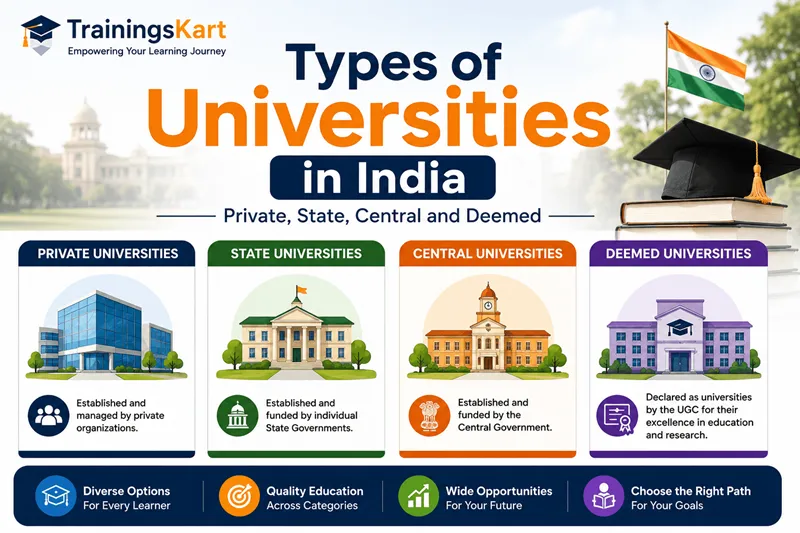
A quick overview:
Central Universities: Created by the parliament, funded by the Central Government.
State Universities: State Legislatures create, and state governments fund them.
Deemed-to-be University: A college or institute with an excellent record in teaching and research, awarded with "Deemed-to-be University" status. On UGC recommendation, the Central Government offers it a university status. The institution can award its own degrees.
Private Universities: State Act establishes them, but they are run and funded by private organisations.
The higher education system in India features 4 main types of universities that receive recognition from the University Grants Commission (UGC): Central, State, Deemed and Private Universities.
While they have UGC validation for granting degrees, they differ in establishment, funds and management.
|
Type (University) |
Primary Funding Source |
Affiliation power? |
|
Central |
Central Government |
Yes |
|
State |
State Government |
Yes |
|
Deemed |
Government or Private (Both) |
No, can not grant affiliation to other colleges |
|
Private |
Private Trust/ society |
No, can not grant affiliation to other colleges |
These are public institutions established by an Act of Parliament and functioning under the Ministry of Education.
Funding: Fully funded by the Central Government
Features: The universities have a lower fee structure, follow the national reservation policies, and offer competitive admissions. They can affiliate with local colleges.
Examples: Delhi University (DU), Jawaharlal Nehru University (JNU) and Banaras Hindu University (BHU)
These are the public institutions established by an Act of the local State Legislative Assembly.
Funding: The state government manages and funds these academic institutions.
Features: They focus on the regional educational needs and reserve a specific seat quota for the regional residents. They can grant affiliation to many local colleges.
Examples: University of Mumbai, University of Calcutta and Anna University.
The high-performing institutes acquire the Deemed-to-be status. This is an autonomous status offered by the Ministry of Education on the UGC recommendation.
They receive university-level acknowledgement due to their academic excellence.
Funding: They receive both government and private funding.
Features: The institutions have freedom to design their own curriculum, syllabus, fees and admission criteria; they can not grant affiliation to any other college.
Examples: Indian Institute of Science (IISC Bangalore), Birla Institute of Technology and Science (BITS Pilani) and Tata Institute of Social Science (TISS).
The state universities are established under the State Legislative Act, through private entities, societies or philanthropic trusts.
Funding: the institutions are fully funded through tuition fees and private investments.
Features: They must follow the UGC guidelines but can conduct their own curriculum, examinations and administration. They can not grant affiliation to other external colleges.
Examples: Amity University, Ashoka and BML Munjal University.
|
Name |
Type (Central) |
NAAC Grade/CGPA |
NIRF University Rank |
Accreditations |
|
Jawaharlal Nehru Univ.(JNU) |
(New Delhi) |
A++, 3.91/4.00 |
2nd |
UGC, Association of Indian Universities (AIU) |
|
University of Delhi (DU) |
(New Delhi) |
A+, 3.28/4.00 |
11th |
UGC, BCI (Law), AICTE (Tech) |
|
Jamia Milia Islamia (JMI) |
New Delhi |
A++, 3.61/4.00 |
3rd |
UGC, AICTE, Council of Architecture (CoA) |
|
University of Hyderabad (UoH) |
Hyderabad, (Telangana) |
A++, 3.72/4.00 |
10th |
UGC, Institution of Eminence IoE Status |
|
Banaras Hindu University (BHU) |
Varanasi, (Uttar Pradesh) |
A, 3.41/4.00 |
5th |
UGC, NMC (Medicine), ICAR (Agriculture) |
|
Name |
Type (State) |
NAAC Grade |
NIRF Rank |
Accreditations |
|
University of Lucknow (LU) |
Lucknow, UP |
A++ |
98th |
UGC, BCI, NCTE |
|
Kin George’s Medical University (KGMU) |
Lucknow, U P |
A |
27th |
National Medical Commission (NMC), DCI (Dental) |
|
Dr APJ Abdul Kalam Technical Univ. (AKTU) |
Lucknow, UP |
B+ |
101-150 |
UGC, AICTE and PCI |
|
Savitribai Phule Pune Univ. |
Pune, Maharashtra |
A+ |
15th |
UGC, AICTE, BCI |
|
Calcutta University |
Kolkata, West Bengal |
A |
12th |
UGC, AICTE, BCI |
|
Name |
Type |
NAAC Grade |
NIRF Ranking |
Accreditations |
|
Dr D.Y. Patil Vidyapeeth |
Pune, Maharashtra |
A++ |
44th |
UGC, AICTE |
|
Amrita Vishwa Viddypeetham |
Coimbatore, Tamil Nadu |
A++ |
7th |
AACSB, AICTE, and medical councils |
|
Manipal Academy of Higher Education (MAHE) |
Manipal, Karnataka |
A++ |
9th |
UGC, NMC (Medical), DCI, Institution of Eminence |
|
SVKM’s NMIMS |
Mumbai, Maharashtra |
A+ |
21st |
AICTE, Elite for MBA, NMAT/ NPAT |
|
Symbiosis International University |
Pune Maharashtra |
A++ |
31st |
UGC, AICTE |
|
Online Universities Name |
State-wise, Private, (Across India) |
NAAC Grade |
NIRF Ranking |
Accreditations |
|
Amity university |
Delhi-NCR, Punjab, Maharashtra, Rajasthan, MP, Bihar |
A+ |
22nd |
UGC, AICTE |
|
SVKM’s NMIMS |
Maharashtra, MP, Bangalore, Hyderabad, Chandigarh |
A+ |
21st |
UGC, AICTE |
|
Manipal Academy of Higher Education (MAHE) |
Karnataka, Rajasthan, Sikkim |
A++ |
9th |
UGC |
|
Lovely Professional Univ. |
Punjab, Maharashtra, Bihar, Rajasthan, Hyderabad |
A++ |
31st |
UGC, AICTE |
|
Sharda University |
UP, Delhi-NCR |
A+ |
87th |
UGC, AICTE |
The best universities for students depend on their career goals, budget and learning environment facilities. Each type of institution offers diverse advantages, so learners must choose one of them according to their academic plans.
Central Universities: Best for research, higher studies (Master’s or PhD programs), affordable and suitable for candidates, preparing for government exams.
State Universities: Offer budget-friendly education, regional job opportunities and are good for state government careers preparation.
Deemed-to-be Universities: Suitable for specialised courses with the latest curriculum and academic focus.
Private Universities: Offer industry-aligned courses, modern technical infrastructure, internships and focus on emerging sectors such as AI, Data Science and Management.
Before taking admission, students must verify the institution’s recognition and quality.
Check UGC Recognition: Check the UGC authentication. The UGC certification makes a degree valid for employment and for higher studies.
Check AICTE, BCI or NMC: For the professional courses such as engineering (B.E./ B.Tech, MBA, etc.), check All India Council for Technical Education (AICTE), for Law (LLB, BA LLB or BBA LLB )courses, check Bar Council of India (BCI).
For medical (MBBS, MD) courses, check the National Medical Commission (NMC) recognition for the standard curriculum.
Verify NAAC Accreditation: Students must select institutions with a good NAAC accreditation with A, A+ or A++.
Confirm Affiliation: Before enrolling in the degree course, check the institution’s status of awarding degrees. Only Central and State Universities can grant affiliation to the colleges, not any Deemed-to-be or Private institutions.
Selecting the right university can make a big difference in education and career. Before taking admission, learners must compare the different institution types and check if the university follows the guidelines from authorised government units or not.
The final verdict:
India has four main types of universities: Central, State, Deemed-to-be and Private.
Each type receives UGC grants for degree awardation, but with different features, fees and learning environment.
Choose a university according to the career goal, budget, course, and relocation needs.
Always check the UGC approval for the institutions and for the course that they are conducting on the official UGC portal before registration.
Students can verify the UGC, NAAC and NIRF authentication and ranking on their official websites.
Ready to select the right one? Explore Trainingskart.com for the latest admission guides, university comparisons and career guidance before making a decision.

|
Amity University Online |

|
Parul University Online |

|
Jain University Online |

|
Chandigarh University Online |

|
Manipal Online University |

 Chat with us